Introduction
A strong, well-developed chest does more than improve appearance. The muscles in the chest power pushing movements used every day, from lifting groceries to pushing open a heavy door. A structured chest workout builds strength, improves upper-body balance, and supports athletic performance.
Many people focus on chest training because it delivers visible results. Exercises such as presses, push-ups, and fly movements activate some of the largest muscles in the upper body. When trained properly, the chest responds quickly to progressive resistance and consistent training.
This guide explains how chest workouts work, the most effective exercises, proper training techniques, common mistakes, and a practical plan for building a stronger chest.
Understanding the Chest Muscles
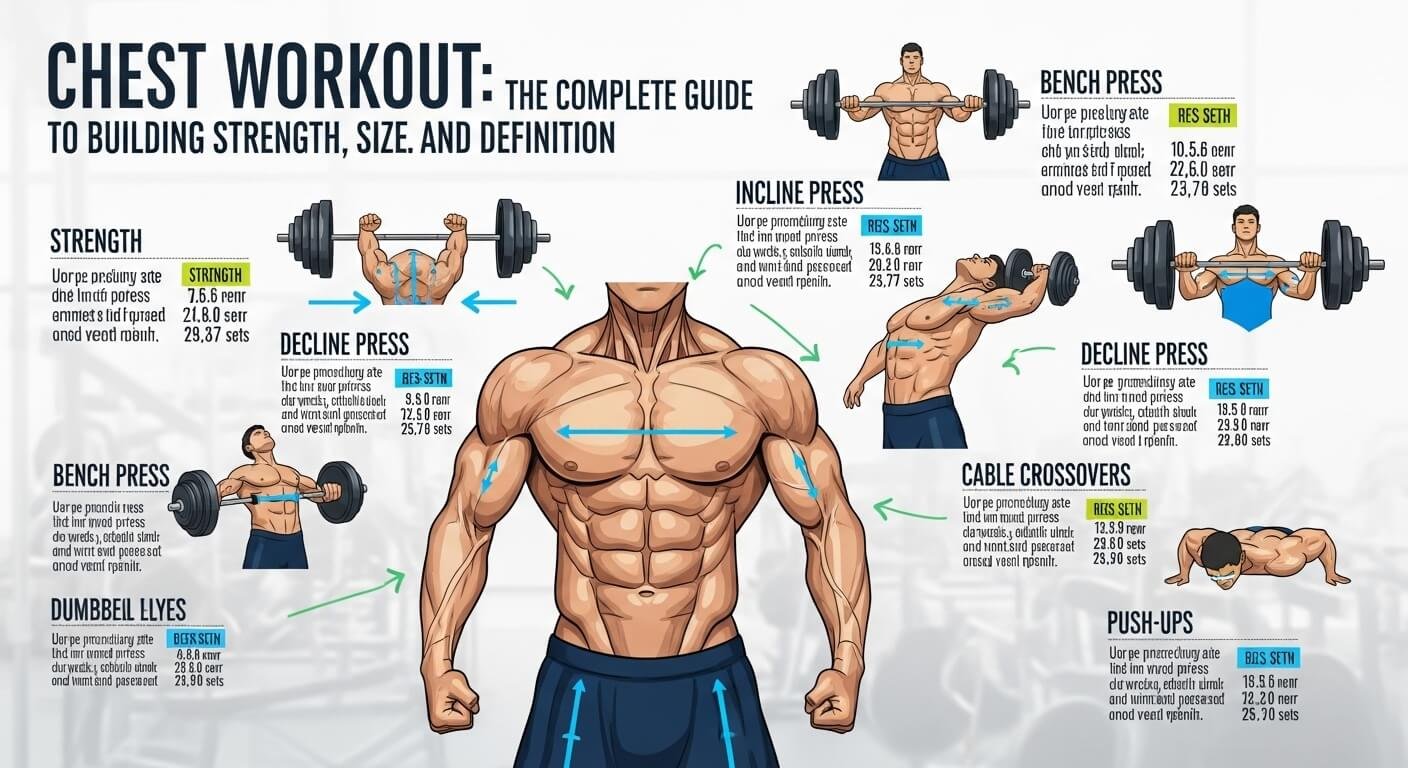
Before designing a chest workout, it helps to understand the anatomy involved. The chest contains several muscles that work together to power pushing movements and stabilize the shoulders.
The Pectoralis Major
The pectoralis major is the largest chest muscle and the primary target of most chest workouts.
It has two main sections:
-
Clavicular head (upper chest) – connects to the collarbone
-
Sternal head (middle and lower chest) – connects to the sternum
These muscle fibers allow the chest to perform several movements:
-
Pushing away from the body
-
Bringing the arms toward the center of the chest
-
Rotating the shoulders inward
Exercises like bench presses heavily activate this muscle.
The Pectoralis Minor
The pectoralis minor sits beneath the pectoralis major.
Its main roles include:
-
Stabilizing the shoulder blade
-
Supporting proper posture
-
Assisting breathing movements
While it’s smaller, strengthening this muscle improves shoulder mechanics during chest workouts.
Supporting Muscles in Chest Training
Chest exercises also involve nearby muscles.
These include:
-
Anterior deltoids (front shoulders)
-
Triceps brachii
-
Serratus anterior
A well-designed chest workout engages these muscles without allowing them to dominate the movement.
Why a Chest Workout Matters for Overall Fitness
Chest training isn’t only about aesthetics. Strong chest muscles improve function, posture, and upper-body strength.
Improved Upper Body Strength
Many everyday activities involve pushing motions.
Examples include:
-
Moving furniture
-
Lifting boxes
-
Getting up from the floor
-
Sports like basketball or football
Strengthening the chest improves power during these tasks.
Better Athletic Performance
Athletes rely on chest strength in multiple sports.
Benefits include:
-
Increased throwing power
-
Stronger punching ability
-
Improved push strength in swimming
-
Better stability during contact sports
Research from sports performance studies shows that upper-body strength strongly correlates with sprint speed and throwing velocity in many athletes.
Posture and Shoulder Stability
Weak chest muscles often lead to compensation by the shoulders.
A balanced chest workout helps:
-
Support the shoulder joints
-
Improve posture
-
Reduce injury risk
When paired with back training, chest exercises create stronger upper-body alignment.
Key Principles for an Effective Chest Workout
Results from chest training depend less on the exercises themselves and more on how they are performed.
Progressive Overload
Muscles grow when gradually exposed to greater stress.
This can be done by:
-
Increasing weight
-
Adding repetitions
-
Increasing training volume
-
Improving technique
Consistent progression stimulates muscle growth and strength gains.
Proper Training Frequency
For most people, chest muscles respond well to two training sessions per week.
Research in strength training suggests this frequency produces better muscle growth compared to once-per-week routines.
Balanced Exercise Selection
A strong chest workout typically includes:
-
Pressing movements for strength
-
Isolation exercises for muscle development
-
Bodyweight exercises for endurance
Combining these creates complete muscle stimulation.
The Best Exercises for a Chest Workout
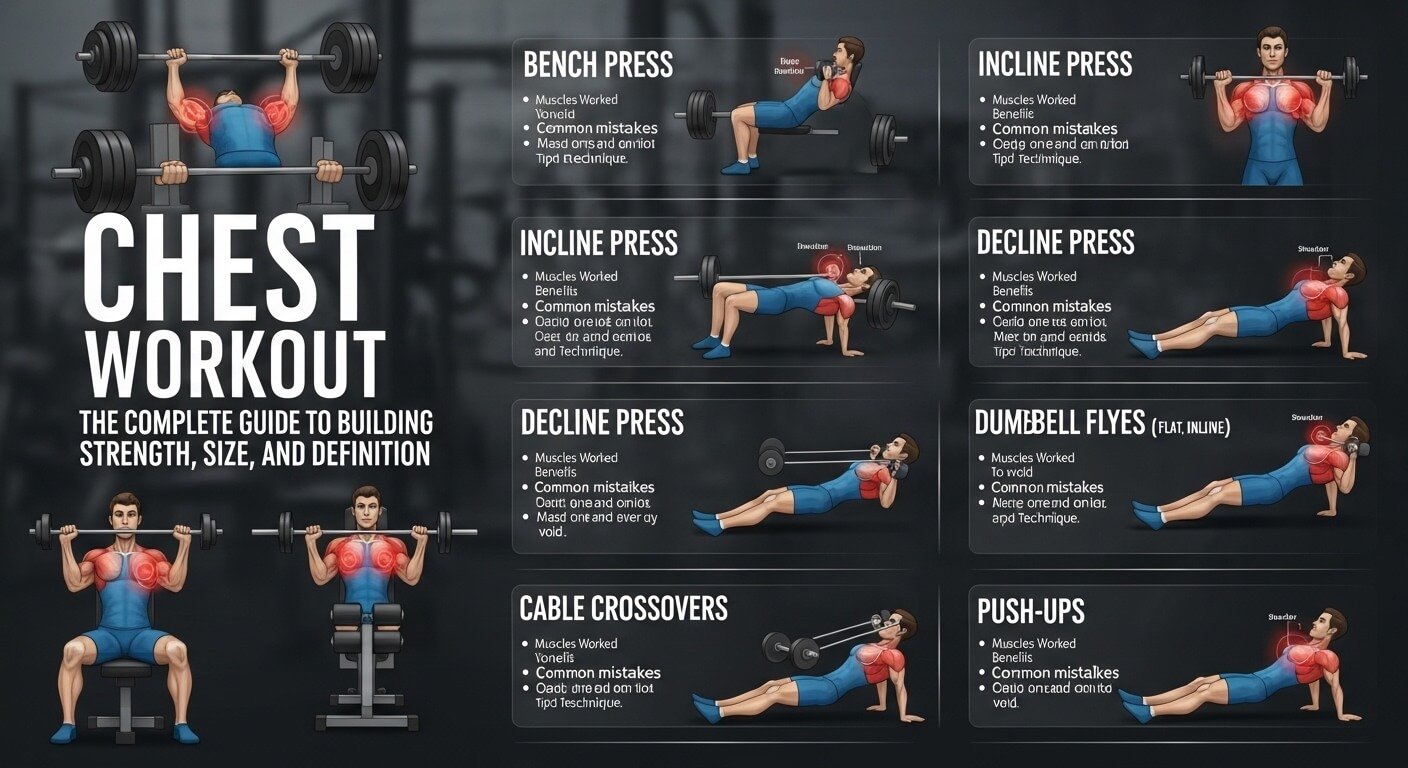
Certain exercises consistently deliver results for building chest strength and size.
Bench Press
The bench press is widely considered the foundation of chest training.
Benefits include:
-
Maximum chest activation
-
Ability to lift heavy weights
-
Strength development across the chest, shoulders, and triceps
Steps for proper execution:
-
Lie flat on a bench with feet firmly planted.
-
Grip the bar slightly wider than shoulder width.
-
Lower the bar slowly to the mid-chest.
-
Push the bar upward until your arms extend fully.
Proper form prevents shoulder strain.
Push-Ups
Push-ups remain one of the most effective bodyweight chest exercises.
Advantages include:
-
No equipment required
-
Builds muscular endurance
-
Activates chest, core, and shoulders
Variations increase difficulty:
-
Decline push-ups
-
Diamond push-ups
-
Weighted push-ups
Dumbbell Chest Press
Dumbbells allow a greater range of motion than barbells.
Key benefits:
-
Improved muscle balance
-
Greater chest stretch
-
Reduced joint stress
Many trainers recommend dumbbells for beginners learning chest control.
Chest Fly
Fly movements isolate the chest muscles more directly.
They involve bringing the arms together in a hugging motion.
Common versions include:
-
Dumbbell fly
-
Cable fly
-
Machine fly
These exercises emphasize muscle contraction rather than heavy lifting.
Structuring a Complete Chest Workout
A balanced routine combines compound lifts and isolation exercises.
Example Beginner Chest Workout
Perform this routine 1–2 times weekly.
-
Bench Press — 4 sets of 6–8 reps
-
Push-Ups — 3 sets of 10–15 reps
-
Dumbbell Chest Press — 3 sets of 8–10 reps
-
Chest Fly — 3 sets of 10–12 reps
Rest 60–90 seconds between sets.
Intermediate Chest Workout Plan
As strength improves, volume and variation increase.
-
Incline Bench Press — 4 sets of 6–8 reps
-
Flat Dumbbell Press — 3 sets of 8–10 reps
-
Cable Fly — 3 sets of 10–12 reps
-
Decline Push-Ups — 3 sets of 12–15 reps
-
Chest Dips — 3 sets of 8–12 reps
This routine targets upper, middle, and lower chest fibers.
Weekly Chest Training Split
A common schedule includes:
-
Day 1: Chest and triceps
-
Day 2: Back and biceps
-
Day 3: Legs
-
Day 4: Rest or cardio
-
Day 5: Chest-focused workout again
This structure provides adequate recovery.
Common Chest Workout Mistakes
Many people train their chest regularly but fail to see progress because of poor technique or programming.
Using Too Much Weight
Lifting heavier than your muscles can control reduces chest activation.
Instead of engaging the chest, the body compensates with:
-
Shoulders
-
Lower back
-
Momentum
Lower weight with strict form produces better results.
Poor Range of Motion
Partial repetitions limit muscle development.
Full range movements stretch and contract muscle fibers fully.
Good chest exercises involve:
-
Controlled lowering
-
Full extension at the top
-
Slow eccentric motion
Ignoring the Upper Chest
Many routines focus heavily on flat bench presses.
This neglects the upper chest area.
Incline exercises help build balanced chest development.
Pros and Cons of Chest Workouts
Like any training approach, chest workouts have strengths and limitations.
Pros
-
Builds upper-body strength
-
Improves posture when balanced with back training
-
Enhances athletic performance
-
Increases muscle mass
-
Supports pushing movements
Cons
-
Overtraining can strain the shoulders
-
Poor technique increases injury risk
-
Excessive chest training without back work creates muscle imbalance
Balancing chest exercises with pulling movements prevents posture problems.
Comparing Chest Workout Methods
Different training styles affect chest development.
Free Weights vs Machines
Free weights
Pros:
-
Activate stabilizing muscles
-
Greater range of motion
-
Functional strength development
Cons:
-
Require more technique
-
Higher injury risk for beginners
Machines
Pros:
-
Easier to learn
-
Controlled movement pattern
-
Lower injury risk
Cons:
-
Reduced stabilizer activation
-
Limited natural movement
Many experienced trainers combine both methods.
Bodyweight vs Weight Training
Bodyweight training
-
Ideal for beginners
-
Improves endurance
-
Requires minimal equipment
Weight training
-
Builds greater muscle size
-
Allows progressive overload
-
Provides more exercise variety
A combination often produces the best results.
Injury Risks and Safety Tips
Chest workouts are generally safe when performed correctly, but certain mistakes increase injury risk.
Shoulder Strain
Improper bench press technique can stress the shoulders.
Prevention tips:
-
Keep shoulder blades retracted
-
Avoid flaring elbows excessively
-
Use a moderate weight
Muscle Imbalances
Overdeveloped chest muscles without back training can pull the shoulders forward.
Balance training by including exercises like:
-
Rows
-
Pull-ups
-
Face pulls
Overtraining
The chest requires recovery like any muscle group.
Warning signs include:
-
Persistent soreness
-
Decreasing strength
-
Joint discomfort
Allow at least 48 hours between chest workouts.
Nutrition and Recovery for Chest Growth
Training stimulates muscle growth, but nutrition and recovery determine how well muscles develop.
Protein Intake
Protein supports muscle repair.
Most fitness experts recommend:
-
1.6–2.2 grams of protein per kilogram of body weight daily
Good protein sources include:
-
Lean meats
-
Eggs
-
Dairy
-
Fish
-
Legumes
Sleep and Recovery
Muscle growth occurs during recovery periods.
Adults should aim for 7–9 hours of sleep per night.
Poor sleep reduces muscle repair and hormone balance.
Hydration
Hydrated muscles perform better and recover faster.
Drinking enough water helps maintain strength during workouts.
Building Consistency in Chest Training
Consistency determines long-term results.
Effective strategies include:
-
Following a structured program
-
Tracking weights and repetitions
-
Gradually increasing training intensity
-
Maintaining proper technique
Even modest improvements over time lead to significant strength gains.
Many experienced lifters add 2–5 pounds to lifts every few weeks, gradually building impressive chest strength.
Final Thoughts
A well-structured chest workout develops far more than a visually impressive upper body. Strong chest muscles support daily movement, improve athletic performance, and help stabilize the shoulders during demanding tasks. When combined with proper technique, balanced training, and adequate recovery, chest exercises deliver reliable strength and muscle growth.
The most effective routines focus on compound movements such as presses, supported by isolation exercises and bodyweight training. Progressive overload, proper form, and consistent effort transform simple chest workouts into powerful tools for building long-term strength.