Introduction
The electricity grid was never designed for the energy landscape we have today. It was built around the assumption that power generation could be ramped up or down to match demand at any given moment. Fossil fuel plants are good at that. Solar panels and wind turbines are not. They generate power when the sun shines and the wind blows, not necessarily when people need it.
That mismatch is the central problem that BESS solves. The BESS definition, in its most precise form, is a system that captures electrical energy, stores it in electrochemical form, and releases it back to the grid or to a specific load when needed. But understanding what BESS really means, and why it has gone from a niche technology to a cornerstone of modern energy infrastructure, requires a deeper look at what these systems actually do, how they work, and where the technology is headed.
BESS Definition: The Technical Breakdown
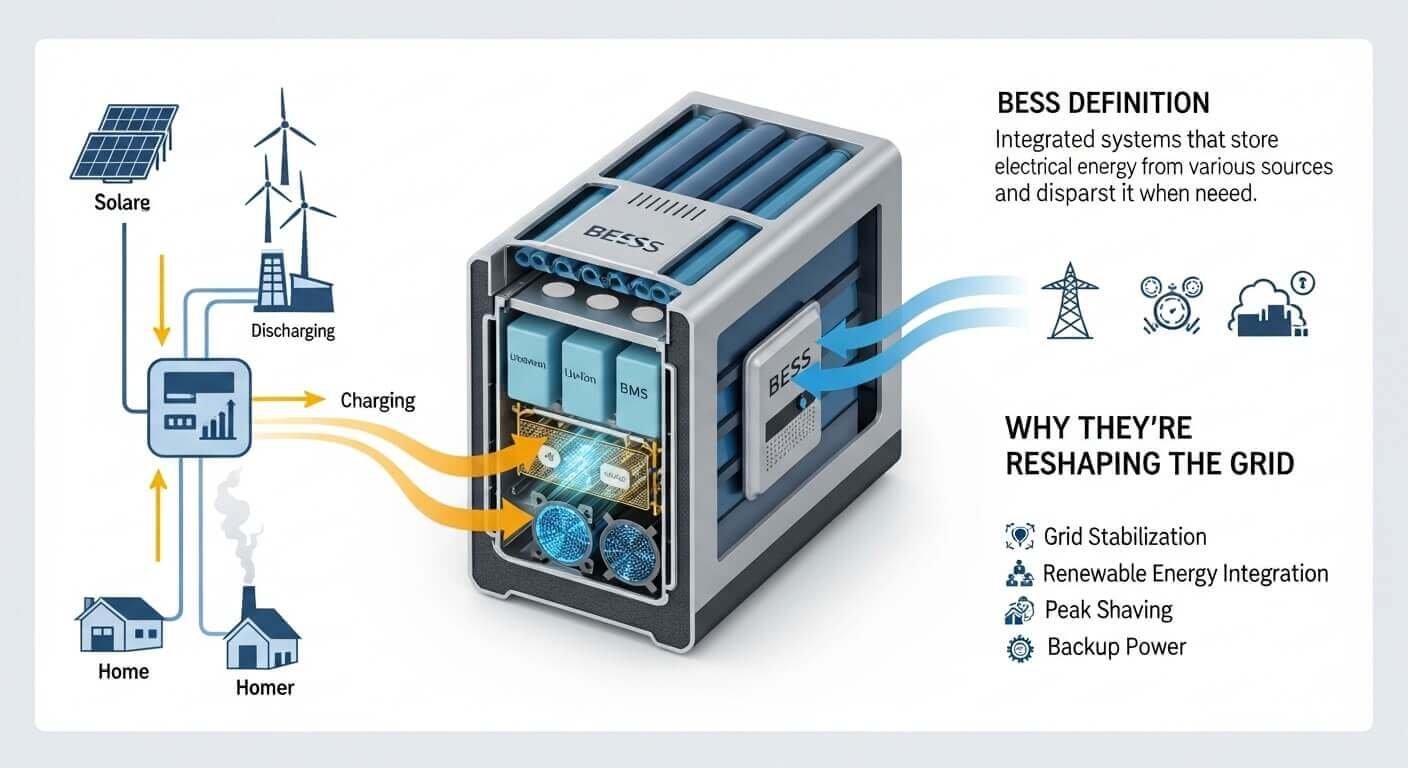
A Battery Energy Storage System is an integrated assembly of batteries, power conversion equipment, and control systems designed to store and dispatch electrical energy on demand. The word “system” in the name matters. A BESS is not simply a large battery. It is an engineered solution that combines multiple components working together.
The core components of any BESS include:
- Battery modules: The electrochemical cells where energy is stored, most commonly lithium-ion today, though other chemistries are gaining ground
- Battery Management System (BMS): Software and hardware that monitors cell temperature, voltage, and state of charge to protect the batteries and maximise their lifespan
- Power Conversion System (PCS): Inverts DC power from the batteries to AC power for grid use, and reverses that process during charging
- Energy Management System (EMS): The intelligent control layer that decides when to charge, when to discharge, and how to respond to grid signals or operator commands
- Thermal management system: Keeps batteries operating within safe temperature ranges, especially critical at utility scale
- Grid interconnection equipment: Transformers, switchgear, and protection systems that connect the BESS to the broader electrical network
The Difference Between a BESS and a Simple Battery
This distinction trips up a lot of people encountering the BESS definition for the first time. A home UPS (uninterruptible power supply) is a battery. A BESS is a system engineered to perform specific grid functions, respond to control signals, and operate safely and reliably over years or decades of cycling.
The engineering complexity scales enormously with size. A residential BESS like a Tesla Powerwall contains around 13 kilowatt-hours of usable energy. A utility-scale BESS might contain hundreds of megawatt-hours, occupying the footprint of several football fields and requiring the same level of infrastructure planning as a small power plant.
How Energy Capacity and Power Capacity Differ
One of the most important nuances in understanding BESS is the difference between energy capacity and power capacity. Energy capacity, measured in kilowatt-hours (kWh) or megawatt-hours (MWh), is how much total energy the system can store. Power capacity, measured in kilowatts (kW) or megawatts (MW), is how fast it can deliver or absorb that energy.
A 100 MW / 400 MWh system can deliver 100 megawatts of power for four hours. A 100 MW / 100 MWh system can deliver the same power for only one hour. The ratio between power and energy capacity determines what grid services a BESS is best suited to provide.
Why BESS Matters: The Energy Storage Revolution in Numbers
The global energy storage market has moved from academic curiosity to critical infrastructure in less than a decade. According to the International Energy Agency, grid-scale battery storage capacity worldwide exceeded 45 gigawatts by the end of 2023, up from just 1 gigawatt in 2013. BloombergNEF projects that number will grow to over 400 gigawatts by 2030.
The cost driver behind this growth is dramatic. Lithium-ion battery pack prices fell roughly 90% between 2010 and 2023, from over $1,100 per kilowatt-hour to around $139 per kilowatt-hour. That cost trajectory, steeper than almost any technology in industrial history, has made BESS economically competitive in markets where it was simply unaffordable a few years ago.
The United States alone installed a record amount of battery storage in 2023, with the Energy Information Administration tracking over 15 gigawatts of installed utility-scale battery capacity by mid-year. California, Texas, and Arizona lead deployments, driven by high renewable penetration and increasing grid stress during extreme weather events.
BESS Applications: What These Systems Actually Do
The BESS definition is most clearly understood by looking at the jobs these systems perform. Battery energy storage is not a single-use technology. A well-configured BESS can provide multiple grid services simultaneously or be optimised for one specific application, depending on its design.
Frequency Regulation
The electricity grid operates at a very precise frequency, 60 Hz in North America and 50 Hz in most of the rest of the world. When generation and load fall out of balance, frequency deviates from the target. Too much deviation trips protective relays and can cause cascading failures.
BESS excels at frequency regulation because it can respond in milliseconds, far faster than any thermal generator can ramp its output. Grid operators pay a premium for this capability. Frequency regulation was actually the application that first made utility-scale BESS commercially viable in markets like PJM in the eastern United States, where fast-response regulation resources command significantly higher payments than slower alternatives.
Peak Shaving and Load Shifting
Electricity prices are not static. They spike during periods of high demand, particularly on hot summer afternoons when air conditioning load surges. Utilities and large industrial customers pay demand charges based on their peak consumption during any given billing period.
A BESS charged during off-peak hours and discharged during peak periods reduces that demand charge exposure significantly. This application, often called peak shaving, can generate substantial savings for commercial and industrial customers even without any grid-level interaction. At the utility scale, the same principle applies to load shifting, moving surplus renewable generation from midday into the evening demand peak.
Renewable Energy Integration and Firming
Solar generation in most markets follows a predictable curve: near zero at night, rising through the morning, peaking at midday, and falling in the afternoon. The problem is that electricity demand does not follow that curve. Evening demand, when people return home and cook dinner, often exceeds midday demand.
BESS can capture excess solar generation during the midday peak and dispatch it in the evening, effectively turning variable solar into a more predictable, dispatchable resource. This function, called renewable firming or solar-plus-storage, has become one of the dominant commercial models for utility-scale BESS in markets with high solar penetration.
Backup Power and Resilience
At the commercial, industrial, and residential scale, BESS provides backup power during grid outages. Unlike diesel generators, a BESS responds instantaneously to a grid interruption, with no startup delay and no fuel logistics. For critical facilities like data centres, hospitals, and emergency services, that instantaneous response is essential.
Microgrids, which combine local generation (often solar) with BESS and smart controls, can island from the main grid during outages and continue operating indefinitely as long as generation matches local load. This application is growing rapidly in regions prone to wildfires, hurricanes, and other extreme weather events that cause extended outages.
BESS Technology Types: Not All Storage Is the Same
The BESS definition encompasses several different battery chemistries, each with distinct performance characteristics, cost profiles, and appropriate use cases. Understanding the differences matters when evaluating a specific project or deployment.
Lithium-Ion: The Dominant Chemistry
Lithium-ion batteries currently account for the large majority of deployed BESS capacity worldwide. Within lithium-ion, several cathode chemistries are in use:
- LFP (Lithium Iron Phosphate): Increasingly dominant at utility scale due to its thermal stability, long cycle life, and lower cost. Less energy-dense than other lithium-ion chemistries but significantly safer.
- NMC (Nickel Manganese Cobalt): Higher energy density than LFP, making it popular for applications where space is constrained. More expensive and requires more careful thermal management.
- NCA (Nickel Cobalt Aluminium): Used primarily in automotive applications. Less common in stationary storage.
LFP has become the chemistry of choice for most new utility-scale projects, particularly in the United States and China, for its combination of safety, cost, and longevity.
Emerging Alternatives Worth Watching
Several non-lithium-ion technologies are advancing toward commercial deployment:
- Flow batteries (vanadium redox): Store energy in liquid electrolyte tanks rather than solid cells. Energy and power capacity can be scaled independently, making them attractive for long-duration storage. Lower cycle degradation than lithium-ion over very long periods.
- Sodium-ion: Emerging chemistry that uses sodium instead of lithium. Lower cost potential, wider material availability, but lower energy density in current iterations.
- Iron-air batteries: Long-duration technology that uses the rusting and de-rusting of iron to store and release energy. Form Energy and others are developing commercial versions targeting 100-hour storage, far beyond what lithium-ion can economically achieve.
- Gravity storage and compressed air: Not battery-based in the electrochemical sense, but compete in the long-duration storage space.
Pros and Cons of Battery Energy Storage Systems
BESS is not a perfect technology, and understanding its limitations is as important as understanding its capabilities.
Advantages:
- Near-instantaneous response to grid signals
- No direct emissions during operation
- Modular and scalable from kilowatts to gigawatts
- Declining costs are making more use cases economically viable
- Capable of providing multiple grid services simultaneously
- Low maintenance compared to thermal generation
- Can be sited at or near the load, reducing transmission requirements
Disadvantages:
- Finite cycle life: batteries degrade over charge/discharge cycles and calendar time
- Energy-to-cost ratio still limits economic storage duration to 4-8 hours for most lithium-ion systems
- Thermal runaway risk in lithium-ion cells requires careful design and fire suppression systems
- Raw material supply chains for lithium, cobalt, and nickel face geopolitical and environmental concerns
- End-of-life battery recycling infrastructure is still maturing
- Upfront capital costs remain significant for smaller deployments without access to utility-scale pricing
BESS vs. Alternative Energy Storage Technologies
Battery energy storage competes with several alternative technologies depending on the application and duration of storage required.
Pumped hydro storage is the dominant form of grid-scale energy storage globally by installed capacity. It stores energy by pumping water uphill and recovers it by releasing water through turbines. It is cost-effective at very large scales and extremely long lifetimes, but requires specific geographic conditions and faces significant permitting barriers for new projects. BESS wins on siting flexibility, response speed, and scalability without geographic constraint.
Compressed air energy storage (CAES) stores energy by compressing air into underground caverns or tanks. It can provide long-duration storage but requires suitable geology and has relatively low round-trip efficiency compared to lithium-ion BESS.
Thermal storage, particularly molten salt paired with concentrated solar power, is effective for shifting solar generation but is specific to large-scale solar thermal plants rather than a general-purpose grid resource.
Hydrogen storage, often discussed as the long-duration solution of the future, faces significant round-trip efficiency penalties. Converting electricity to hydrogen via electrolysis and back to electricity via a fuel cell currently loses roughly 60-70% of the original energy. BESS round-trip efficiency for lithium-ion typically exceeds 85-92%.
For durations up to about eight hours, BESS is now the most cost-competitive and practical solution in most markets. Beyond eight hours, the economics shift toward alternatives, particularly pumped hydro for proven technology and flow batteries or iron-air for emerging options.
Red Flags and Risks in BESS Deployment
Battery energy storage is a proven technology, but deployments are not without risk. Understanding where things can go wrong is essential for developers, investors, and policymakers.
Thermal runaway and fire risk is the most discussed safety concerns in BESS. Lithium-ion cells under certain conditions, including overcharging, physical damage, or manufacturing defects, can enter thermal runaway, a self-sustaining exothermic reaction that generates intense heat and can propagate through adjacent cells. Several utility-scale BESS fires, including incidents in Arizona, South Korea, and California, have prompted significant improvements in fire suppression standards and building codes. LFP chemistry substantially reduces this risk compared to earlier NMC deployments.
Degradation assumptions in financial models deserve scrutiny. A BESS that degrades faster than projected delivers less revenue over its lifetime. Independent engineering assessments of degradation rates and cycle life claims are standard practice in project finance for good reason.
Interconnection timelines have become a serious constraint. In the United States, the queue for grid interconnection approval for new energy resources, including BESS, now stretches for years in most regions. Projects that do not account for this in their development timelines face significant delays.
Market design mismatches exist in some electricity markets where BESS is technically capable of providing services that it is not permitted to participate in or is not adequately compensated for. FERC Order 841 in the United States removed many of these barriers at the federal level, but state-level market design continues to evolve unevenly.
The Evolving BESS Definition in Policy and Regulation
The regulatory definition of BESS matters in ways that directly affect project economics. How a jurisdiction classifies battery storage determines what permits it needs, what grid services it can provide, what incentives it qualifies for, and how it is taxed.
The United States Investment Tax Credit (ITC) extension under the Inflation Reduction Act now applies to standalone BESS, not just storage paired with solar. This change, which took effect in 2023, dramatically improved the economics of standalone storage projects and triggered a wave of new development activity.
In the European Union, the Clean Energy Package and subsequent amendments have worked to clarify the regulatory status of energy storage, which previously fell into ambiguous categories between generation and consumption assets. Clearer definitions have reduced regulatory barriers to deployment across member states.
Verdict
The BESS definition has expanded considerably in a short time. What began as a technical term for a specific type of backup power equipment now describes one of the most consequential technologies in the transition to a decarbonised electricity system. Battery energy storage systems are not a future promise; they are operational infrastructure being deployed at scale on every continent, solving real grid problems today.
The technology has limitations, the cost curves are not falling, and the policy environment continues to evolve. But the direction of travel is clear. Grids with high renewable penetration need storage, and BESS is currently the most versatile, cost-competitive, and rapidly deployable form of storage. Anyone working in energy, infrastructure, finance, or policy needs a working understanding of what BESS is and what it can do, because the decisions being made right now about where and how to deploy it will shape the electricity system for decades.