Introduction
Few symbols carry as much emotional weight and political significance as the Palestine flag. It is more than fabric stitched in four colors. It represents identity, resistance, heritage, and the enduring aspirations of a people whose story continues to shape global conversations.
Whether you’ve seen it waved in protests, displayed on buildings, or shared across social media, the Palestine flag has become one of the most recognizable national symbols in the world. Understanding what it stands for requires looking beyond its design into the history, meaning, and modern relevance it carries.
The Origins of the Palestine Flag
The Palestine flag traces its roots back over a century, emerging from a broader Arab movement that sought unity and independence.
The Arab Revolt Connection
The design of the Palestine flag is closely tied to the Arab Revolt of 1916 against the Ottoman Empire. During this uprising:
- Arab forces adopted a flag with black, white, green, and red colors
- These colors later became known as Pan-Arab colors
- They symbolized unity among Arab nations
This original design laid the foundation for what would later become the Palestine flag.
Adoption as a National Symbol
The Palestine flag in its current form gained prominence in the 20th century:
- Officially adopted by the Palestine Liberation Organization (PLO) in 1964
- Recognized as the flag of the Palestinian people globally
- Became widely used during the First Intifada in the late 1980s
Despite restrictions at various times, it remained a powerful visual expression of identity.
Evolution Through Conflict and Recognition
Over time, the Palestine flag evolved from a regional symbol into a global emblem:
- Initially tied to Arab nationalism
- Became specific to Palestinian identity
- Gained international visibility through political movements
- Recognized in diplomatic spaces, including the United Nations
Its journey mirrors the political history of Palestine itself.
Meaning Behind the Colors of the Palestine Flag
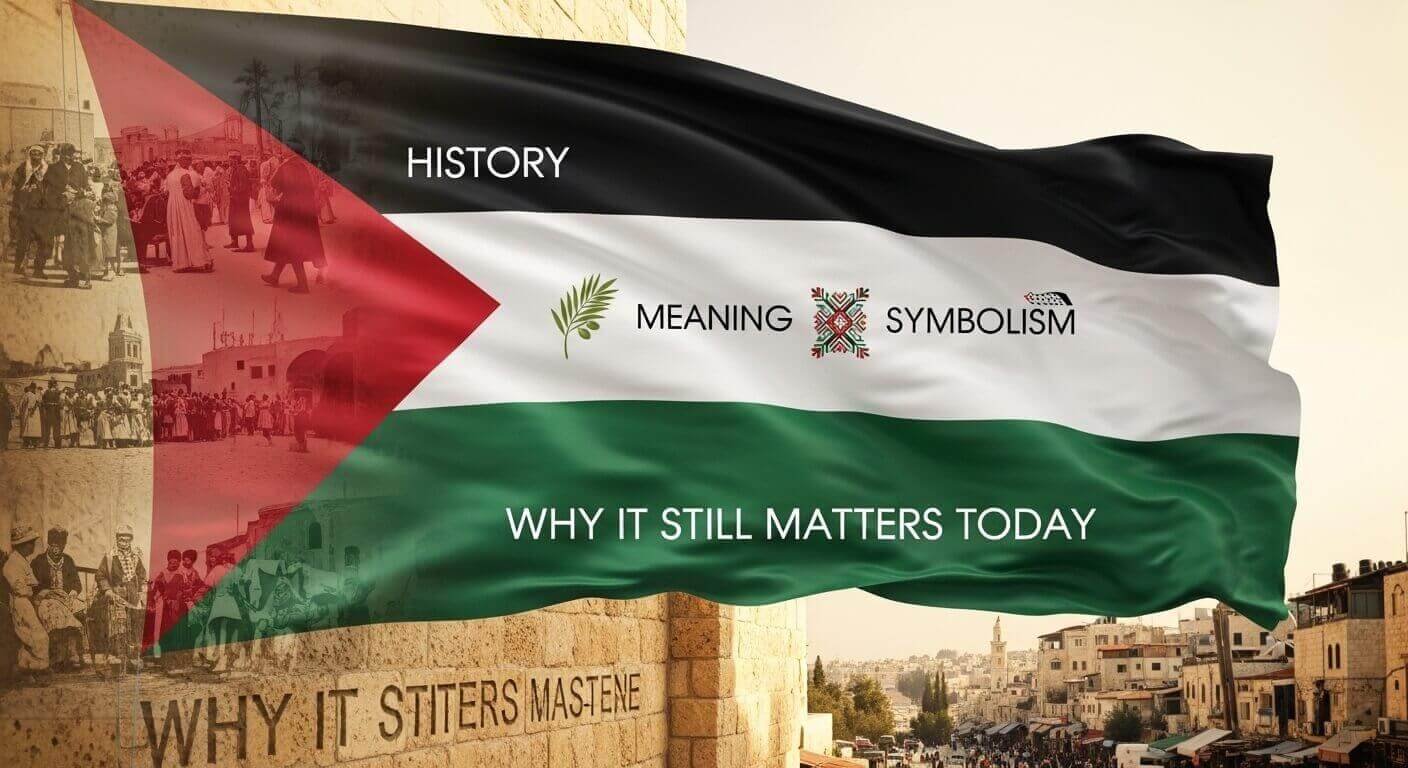
Every color on the Palestine flag carries deep historical and cultural meaning.
Breakdown of the Colors
The flag consists of three horizontal stripes and a triangle:
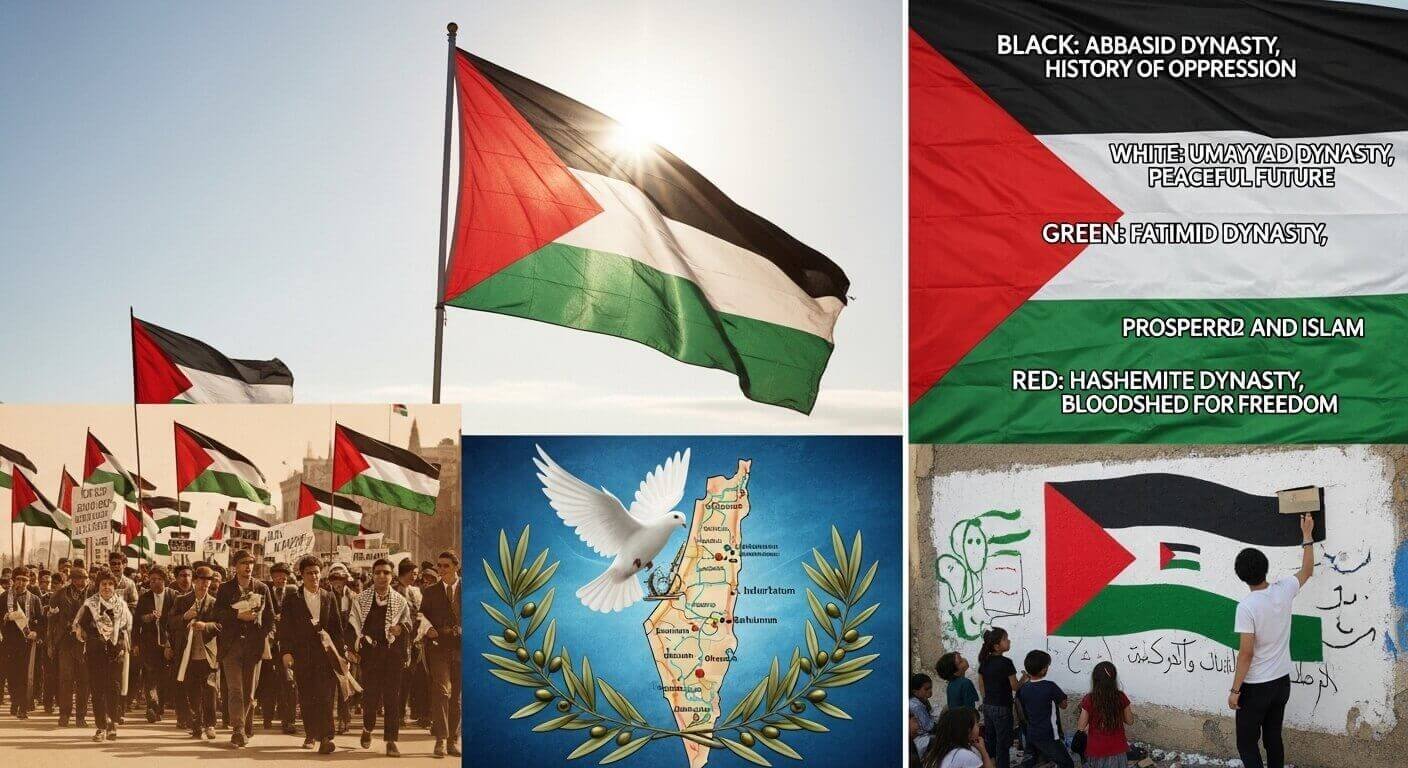
- Black stripe: Represents the Abbasid Caliphate
- White stripe: Symbolizes the Umayyad Caliphate
- Green stripe: Linked to the Fatimid Caliphate
- Red triangle: Represents the Hashemite dynasty and revolutionary struggle
These colors connect modern Palestine to centuries of Arab history.
Symbolism Beyond History
While the historical references are important, the colors have taken on broader meanings:
- Black is often associated with oppression and resilience
- White reflects hope and peace
- Green symbolizes the land and fertility
- Red stands for sacrifice and resistance
Together, they form a narrative of struggle and perseverance.
Why Symbolism Matters Today
The symbolism of the Palestine flag resonates strongly in modern contexts:
- It represents solidarity across borders
- Serves as a visual shorthand for political stance
- Acts as a unifying emblem for Palestinians worldwide
This layered meaning is why the flag continues to inspire strong reactions.
Why the Palestine Flag Matters in Modern Times
The Palestine flag is not just a historical artifact. It plays a central role in current global discourse.
A Symbol of Identity
For Palestinians, the flag represents:
- National identity in the absence of full sovereignty
- Cultural heritage passed through generations
- A shared sense of belonging
It becomes especially important for diaspora communities.
Presence in Global Movements
The Palestine flag frequently appears in international demonstrations:
- Human rights protests
- Student movements
- Political rallies
Its visibility reflects growing global awareness and engagement with Palestinian issues.
Digital Age Amplification
Social media has transformed the reach of the Palestine flag:
- Shared widely during conflicts
- Used as profile images and digital banners
- Integrated into art, memes, and activism
This digital presence has expanded its symbolic power far beyond physical borders.
How the Palestine Flag Compares to Other National Flags
Understanding the Palestine flag also involves comparing it to similar designs and symbols.
Similarities with Other Arab Flags
Several Arab countries use the same color palette:
- Jordan
- Kuwait
- United Arab Emirates
- Iraq
These flags share Pan-Arab colors but differ in arrangement and symbolism.
Key Differences
What makes the Palestine flag unique:
- Simplicity of design
- Absence of additional emblems or text
- Strong association with a stateless national identity
This simplicity enhances its recognizability and impact.
Why Design Matters
Flag design plays a crucial role in symbolism:
- Simple designs are easier to reproduce and share
- Bold colors increase visibility
- Clear symbolism ensures universal understanding
The Palestine flag excels in all these aspects.
Step-by-Step: How to Draw the Palestine Flag Correctly
Drawing the Palestine flag accurately requires attention to proportions and color placement.
Step 1: Create the Base
- Draw a horizontal rectangle
- Divide it into three equal horizontal sections
Step 2: Add the Colors
From top to bottom:
- Black stripe
- White stripe
- Green stripe
Ensure each stripe is equal in height.
Step 3: Draw the Triangle
- Add a red triangle on the left side
- The triangle should extend from top to bottom
- Its point should reach about one-third into the flag
Step 4: Final Touches
- Ensure clean, straight lines
- Use bold, solid colors
- Maintain proper proportions
Following these steps ensures an accurate representation.
Pros and Cons of Strong Symbolism
Like any powerful symbol, the Palestine flag carries both advantages and challenges.
Pros
- Instantly recognizable worldwide
- Strong emotional connection for supporters
- Effective tool for awareness and advocacy
- Represents unity across diverse communities
Cons
- Can be politically polarizing
- Misinterpretation in different contexts
- Restrictions in certain regions or events
- Risk of oversimplifying complex issues
Understanding both sides helps provide a balanced perspective.
Risks and Misuse of the Palestine Flag
With increased visibility comes the risk of misuse or misunderstanding.
Political Sensitivity
Displaying the Palestine flag can lead to:
- Legal restrictions in some areas
- Social or political backlash
- Mislabeling of intentions
Context matters significantly.
Commercial Exploitation
The flag is sometimes used for profit:
- Printed on merchandise without cultural respect
- Used in marketing campaigns lacking authenticity
This can dilute its meaning.
Misinformation
Incorrect representations can spread:
- Wrong color shades
- Incorrect proportions
- Misinterpretation of symbolism
Accuracy is essential when using such a meaningful symbol.
Practical Uses of the Palestine Flag Today
The Palestine flag is used in a variety of settings, both official and informal.
Official Uses
- Government buildings
- Diplomatic events
- International organizations
Cultural and Personal Uses
- Artwork and murals
- Clothing and accessories
- Community gatherings
Activism and Advocacy
- Protest marches
- Awareness campaigns
- Online movements
Its versatility contributes to its global presence.
Key Facts About the Palestine Flag
Here are some important facts that highlight its significance:
- Based on the Arab Revolt flag from 1916
- Uses four Pan-Arab colors
- Recognized internationally as a symbol of Palestine
- Widely used despite political restrictions
- One of the most globally recognized flags without full state sovereignty
These facts underline its historical and political importance.
Final Thoughts on the Palestine Flag
The Palestine flag stands as a powerful symbol of identity, history, and ongoing struggle. Its colors tell a story that spans centuries, while its presence in modern movements shows how deeply it resonates today. More than just a national emblem, the Palestine flag carries the hopes, memories, and determination of millions, making it one of the most meaningful and widely recognized symbols in the world.